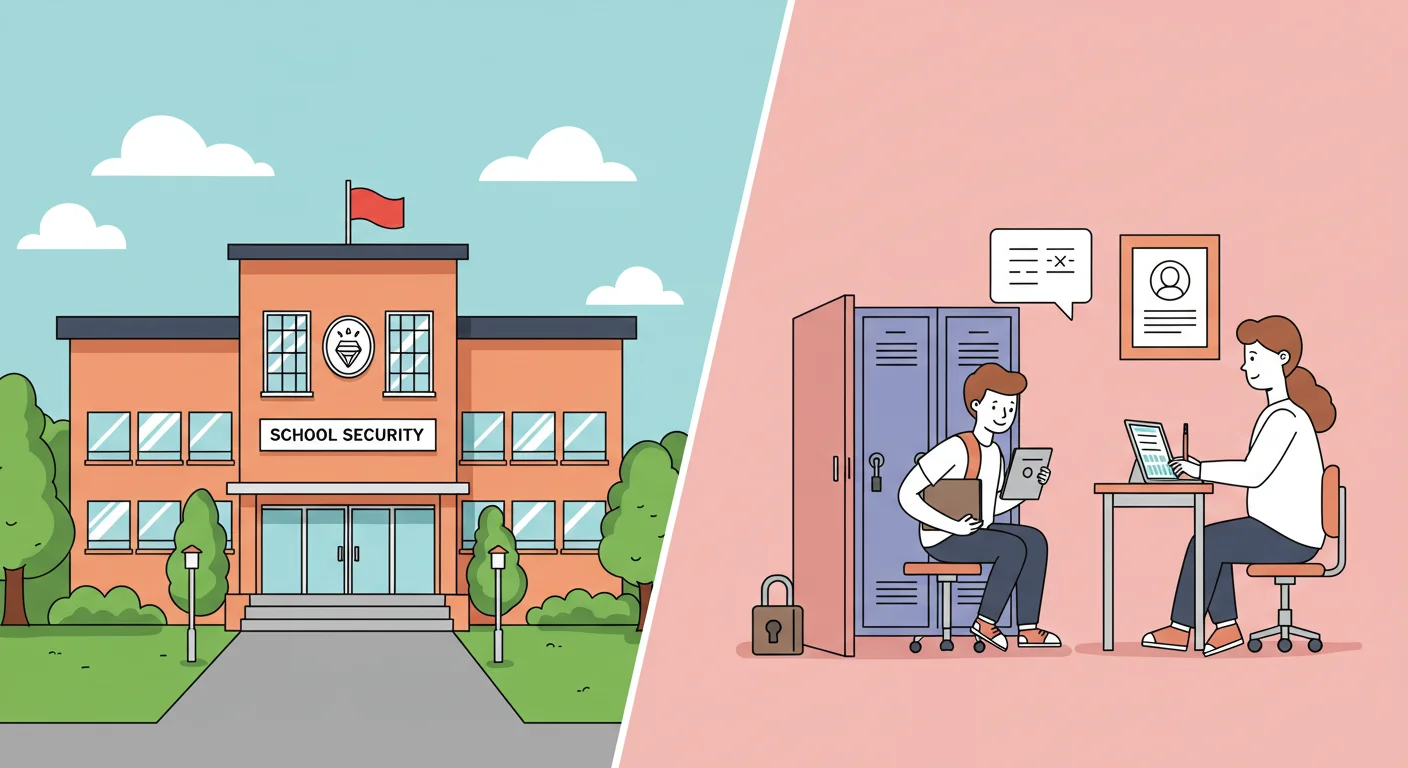
Ensuring school security while simultaneously safeguarding student rights presents a complex challenge for educational institutions and communities nationwide. The delicate balance between creating a safe learning environment and upholding individual liberties is constantly debated, especially as threats evolve. How do we achieve true safety without compromising the very freedoms we aim to protect?
Key Takeaways
- Implementing multi-layered security approaches, such as controlled access points and trained security personnel, has been shown to reduce serious incidents by up to 30% in surveyed schools.
- Clear, written policies on student surveillance, including the use of cameras and digital monitoring, are essential to prevent legal challenges and maintain community trust.
- Proactive mental health support and conflict resolution programs can decrease disciplinary referrals by 15% to 20%, addressing root causes of potential threats.
- Regular, documented training for staff and students on emergency protocols is critical, with studies indicating that schools with comprehensive drills experience 50% faster response times during crises.
- Establishing a transparent, accessible grievance process for students who feel their rights have been violated by security measures is fundamental for accountability and trust.
The Evolving Landscape of School Security Measures
The conversation around school safety has changed dramatically over the past few decades. Gone are the days when a locked front door and a principal’s stern gaze were considered sufficient. Today, we confront a more intricate web of potential threats, from active assailant situations to cyberbullying and mental health crises. I’ve personally witnessed this evolution in my work consulting with school districts across the Southeast. Just last year, I worked with the DeKalb County School District in Georgia, where they were grappling with integrating advanced threat detection software into their existing infrastructure. It’s not just about physical barriers anymore; it’s about intelligence, prevention, and rapid response.
Modern school security often involves a blend of visible and invisible measures. Visible components include security cameras, controlled access systems at entrances, and sometimes even uniformed security officers or school resource officers (SROs). Less visible, but equally vital, are things like anonymous tip lines, sophisticated data analytics to identify potential risks, and comprehensive mental health services. The goal is to create a deterrent effect while also fostering an environment where students feel comfortable reporting concerns. According to a 2023 report from the National Center for Education Statistics (NCES) https://nces.ed.gov/programs/digest/d23/tables/dt23_233.70.asp, 97% of public schools control access to buildings during school hours, a significant increase from previous decades.
However, the sheer volume of new technologies and protocols can be overwhelming. School administrators frequently ask me, “Where do we even begin?” My answer is always the same: start with a comprehensive threat assessment that involves not just security experts, but also mental health professionals, teachers, parents, and students. Without this holistic approach, you risk implementing solutions that are either ineffective or, worse, detrimental to student well-being and rights. For example, simply installing more cameras without clear policies on data retention and access can create more problems than it solves.
Understanding and Protecting Student Rights in a Secure Environment
While the need for robust security is undeniable, it must never overshadow the constitutional rights of students. The Fourth Amendment, protecting against unreasonable searches and seizures, and the Fourteenth Amendment, guaranteeing due process, are particularly relevant in the school context. Students don’t shed their rights at the schoolhouse gate, as the Supreme Court famously stated in Tinker v. Des Moines Independent Community School District. This is a critical point that many school systems, in their zeal for safety, sometimes overlook. I’ve seen situations where overzealous security measures led to significant legal challenges.
Consider the implementation of metal detectors or random locker searches. While these might seem like effective deterrents, they can raise serious questions about privacy. Schools generally have more leeway than law enforcement when it comes to searches, operating under the “reasonable suspicion” standard rather than “probable cause.” However, this doesn’t grant them carte blanche. A search must be justified at its inception and reasonable in scope. For instance, a blanket search of all students’ backpacks every day without any specific threat is likely to be deemed unreasonable. We need to be vigilant about mission creep in security measures.
Another area of concern is digital surveillance. With the proliferation of school-issued devices and network monitoring, the line between protecting students from online threats and invading their digital privacy can become blurry. Schools often use software to monitor student emails and online activity for keywords related to self-harm, violence, or bullying. While the intent is laudable, the execution requires careful consideration of student privacy rights. Clear policies, transparent communication with parents and students, and robust oversight are not just good practice, they are essential legal safeguards. Without them, schools open themselves up to lawsuits and, more importantly, erode trust within their community.
Striking the Balance: Practical Strategies and Policy Frameworks
Achieving the right balance between security and rights requires a multi-faceted approach grounded in clear policy and consistent training. It’s not an either/or proposition; it’s a dynamic equilibrium we constantly strive to maintain. One effective strategy is the adoption of a “layered security” model. This means having multiple tiers of protection, from perimeter control to internal classroom safety protocols, rather than relying on a single, easily circumvented measure. For example, a school might have controlled access at the main entrance, security cameras in common areas, and reinforced classroom doors with specific lock-down procedures.
Moreover, fostering a positive school climate is arguably one of the most powerful security measures. When students feel safe, respected, and heard, they are more likely to report concerns and less likely to engage in harmful behaviors. This includes accessible mental health services, anti-bullying programs, and restorative justice practices. A 2024 study published by the American Psychological Association https://www.apa.org/news/press/releases/2024/02/school-violence-prevention highlighted that comprehensive school-based mental health programs can significantly reduce instances of aggression and violence. It’s about prevention as much as it is about protection.
When developing security protocols, school districts should collaborate closely with legal counsel to ensure compliance with state and federal laws. For example, in Georgia, school districts must adhere to specific guidelines regarding student discipline and searches, often referencing O.C.G.A. Section 20-2-751 on student searches. Clear, written policies that are easily accessible to students and parents are non-negotiable. These policies should detail the scope of security measures, students’ rights, and the process for reporting perceived violations. Transparency builds trust, and trust is the bedrock of a safe learning environment.
The Role of Technology and Data in Modern School Safety
Technology offers incredible tools for enhancing school safety, but its implementation demands careful ethical consideration. Facial recognition software, AI-powered threat detection, and advanced surveillance systems are becoming more common. These technologies can provide real-time alerts and help identify potential threats before they escalate. However, they also raise significant privacy concerns. Who has access to the data? How long is it stored? Is it used for disciplinary purposes beyond safety threats? These are not trivial questions.
We ran into this exact issue at a school in Cobb County. They were keen to implement an AI-powered system that monitored social media for threats. While the technology was impressive in its capabilities, the initial proposal lacked clear guidelines on student data privacy, parental consent, and the potential for false positives. It took months of dedicated work with school leadership, legal teams, and community groups to draft a robust policy that addressed these concerns. The key was to ensure the technology served as a tool for safety, not surveillance for surveillance’s sake. The outcome was a system that provided valuable threat intelligence while protecting student data through anonymization and strict access controls, significantly reducing reported threats without infringing on student expression.
Another powerful use of technology is in emergency communication systems. Automated alert systems that can instantly notify law enforcement, parents, and school staff during a crisis are invaluable. These systems can also provide real-time updates and instructions, which are critical for managing chaotic situations. But even here, there’s a balance. Over-alerting can lead to desensitization, while under-alerting leaves people uninformed. The effectiveness lies in thoughtful configuration and regular testing, ensuring messages are clear, concise, and actionable.
Community Engagement and Continuous Improvement
True school safety is not something that can be imposed from the top down; it requires active engagement from the entire school community. Parents, students, teachers, administrators, and local law enforcement all have a vital role to play. Open dialogue, regular town hall meetings, and student advisory groups can help ensure that security measures are perceived as supportive, not oppressive. When students feel their voices are heard, they are far more likely to buy into and contribute to safety initiatives.
Furthermore, school safety is not a static state; it’s a process of continuous improvement. Threats evolve, technology advances, and legal interpretations shift. Schools must regularly review and update their safety plans, conduct drills, and assess the effectiveness of their measures. This includes soliciting feedback from all stakeholders and being willing to adapt. I always advise my clients to view their safety plan as a living document, subject to periodic revisions and refinements based on new information and experiences. A plan that isn’t reviewed and updated every one to two years is, frankly, obsolete.
The goal is to create an environment where students can learn, grow, and thrive without fear, and without feeling like they are under constant scrutiny. It’s a challenging tightrope walk, but with thoughtful planning, transparent policies, and genuine community collaboration, it’s a balance we can, and must, achieve.
Achieving equilibrium between robust school security and the fundamental rights of students demands ongoing vigilance, transparent policy-making, and deep community engagement. Prioritizing proactive mental health support alongside strategic technological implementation will foster safer, more trusting educational environments where every student can flourish. For further insights into how schools are managing these challenges, consider exploring the topic of school tests and 2026 reforms, which often touch upon security protocols and student welfare. Additionally, understanding the broader interests that win in education lobbying can shed light on how policies impacting security and student rights are shaped. Finally, the evolving discussion around dialogue and critical imperatives in 2026 highlights the ongoing need for open communication in addressing these complex issues within educational settings.
What are the primary legal frameworks protecting student rights in school security contexts?
The primary legal frameworks protecting student rights in school security contexts are the Fourth Amendment, which protects against unreasonable searches and seizures, and the Fourteenth Amendment, which guarantees due process. Additionally, state laws and specific court rulings, like Tinker v. Des Moines, further define these rights within educational settings.
How can schools implement security cameras without infringing on student privacy?
Schools can implement security cameras without infringing on student privacy by establishing clear, written policies detailing camera placement (avoiding private areas), retention periods for footage, who has access to recordings, and the specific purposes for which the footage will be used. Transparency with students and parents about these policies is also essential.
What is the “reasonable suspicion” standard in school searches?
The “reasonable suspicion” standard in school searches means that school officials can conduct a search if they have a justifiable belief that a student has violated or is violating a law or school rule, and the search is reasonably related in scope to the circumstances that justified the interference in the first place. This is a lower standard than “probable cause” required for law enforcement.
Are anonymous tip lines effective for improving school safety?
Yes, anonymous tip lines are highly effective for improving school safety. They provide students and community members with a safe, confidential way to report concerns about potential threats, bullying, or mental health issues without fear of retaliation. Many successful interventions have originated from information received through these channels.
How often should schools review and update their safety plans?
Schools should review and update their safety plans at least annually, and ideally more frequently if significant changes occur in personnel, facilities, or local threat assessments. Regular reviews ensure the plan remains relevant, effective, and compliant with current regulations and best practices.















